صحافة الكترونية مرخصة وزارة الاعلام ترخيص رقم 366-2019

صحافة الكترونية مرخصة وزارة الاعلام ترخيص رقم 366-2019
State of Kuwait: 8-4-2026
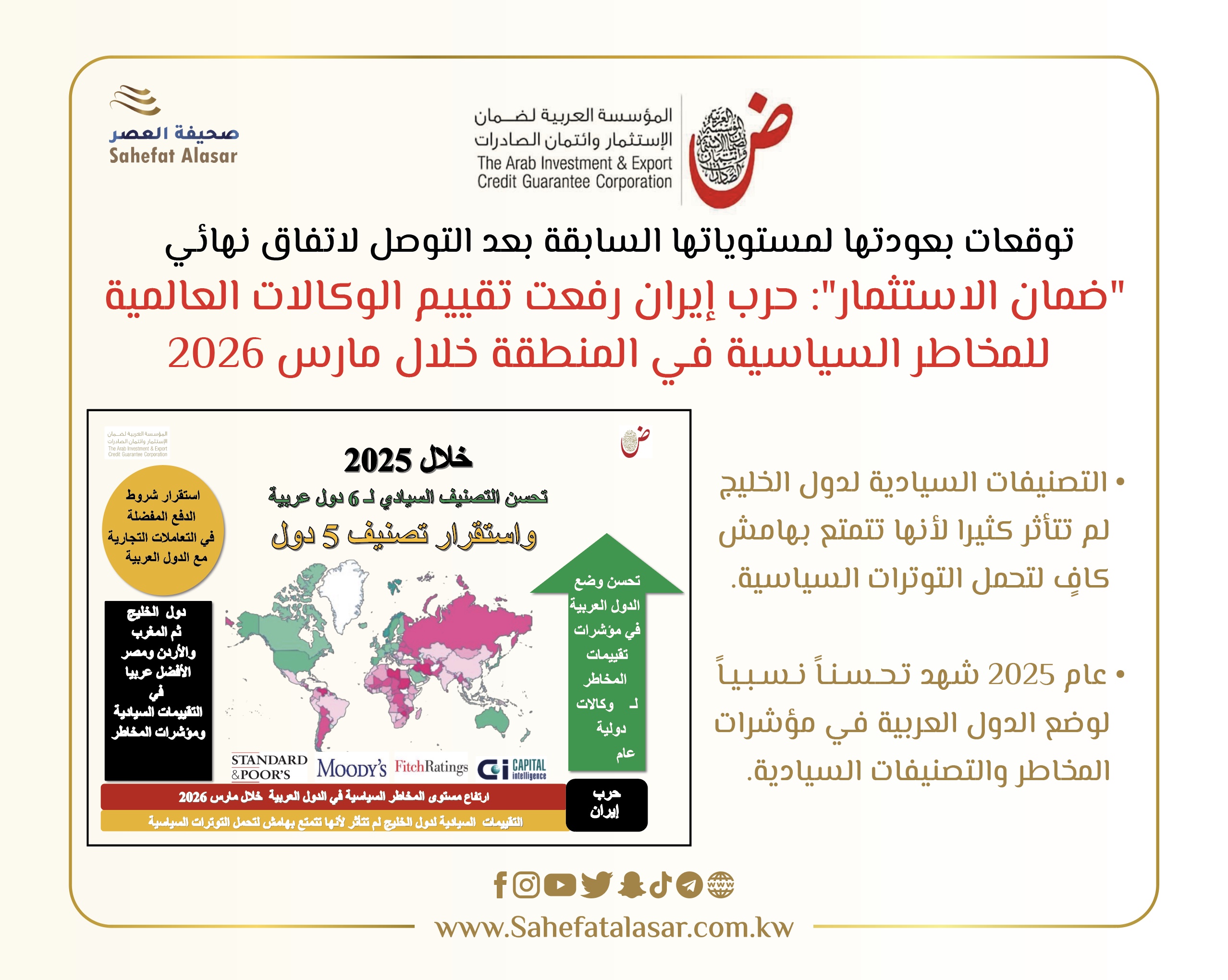
The Arab Investment & Export Credit Guarantee Corporation (Dhaman) revealed that following the outbreak of war between the USA and Israel on one side and Iran on the other side on February 28, 2026, risk levels in Arab countries increased during March 2026, according to the monthly report of the Political Risk Services (PRS). With expectations that it will return to its previous levels after the two-week truce comes into effect, the Strait of Hormuz is reopened, and there are possibilities of reaching a final agreement to end the war.
However, the Corporation indicated in its first quarterly bulletin, “Dhaman Al-Istithmar” for 2026, that the sovereign ratings of Arab countries, particularly the Gulf Cooperation Council (GCC) countries, have an adequate margin to withstand a regional conflict, provided that it is short-term and does not extend to strike oil industry infrastructure or continue to disrupt supplies through the Strait of Hormuz.
This development comes after Arab countries witnessed a relative improvement in sovereign, political, and commercial risk ratings during 2025, despite geopolitical tensions due to the continued Israeli aggression and tensions in occupied Palestine, Lebanon, Syria, Iraq, Yemen, Sudan, and Somalia.
Recognizing the significance of sovereign and risk rating indicators in assessing the interest of multinationals and regional and world financing, investment, and trade institutions in Arab countries, the Corporation continued to monitor these indicators for 2025, highlighting the following findings:
Only eight Arab countries: UAE, Qatar, Kuwait, Saudi Arabia, Oman, Jordan, Bahrain, and Egypt, were rated by the world’s four main credit rating agencies of Standard & Poor’s (S&P), Moody’s, Fitch, and Capital Intelligence. Morocco, Iraq, and Lebanon · were rated by three agencies, and Tunisia by only two, while other countries were not rated at all until 2025.
· Saudi Arabia, Oman, Egypt, Morocco, and Tunisia advanced, while five Arab countries remained unchanged in the sovereign rating. Bahrain declined, and Kuwait was mixed.
· The Gulf Cooperation Council (GCC) countries, Morocco, Jordan, and Egypt maintained the Arab lead in most sovereign ratings and risk indicators.
· The average global ranking of Arab countries advanced in Fitch's Country Risk Index, buoyed by an improvement in the rankings of 14 Arab countries led by Qatar, Jordan, and Lebanon, at the end of 2025.
· The average global ranking of Arab countries in the PRS Composite Country Risk Index improved thanks to the advanced rankings of nine countries, led by Egypt, Morocco, and Iraq.
· The ranking of Arab countries improved in the country risk indexes of Allianz Trade in both short and medium terms, Atradius, Dun & Bradstreet, the Organization for Economic Co-operation and Development (OECD), and Japan’s NEXI.
· The ranking of Arab countries also advanced in Credendo’s business environment risk index at the end of 2025, which is related to country export deals, backed by the better rankings of Morocco, Tunisia, and Egypt, and stable rankings of 17 index-listed countries.
· The status of Arab countries advanced in the Coface Country Risk Index due to an improvement in the UAE, Saudi Arabia, and Oman, and stability in other index-listed countries. while the position of Arab countries declined slightly in the Coface Business Climate Assessment index.
· The preferred payment terms for trade deals with Arab countries remained the same, with Qatar, UAE, Kuwait, and Saudi Arabia offering the most favorable payment terms for concluding deals, as international exporters prefer to do business with them on open account.
The Corporation urged Arab governments to set up high-level committees involving all relevant Arab stakeholders to implement urgent and all-out blueprints to monitor and upgrade country rankings in sovereign and risk rating indicators, with a view to improving the Arab investment climate. In this regard, the Corporation underlined that it is ready to play its part in compiling specialized and thorough reports on Arab countries’ positions, while stressing the significance of communication with the research teams responsible for issuing these indicators to help carry out reforms and advance the status of the region’s countries.